Building AI products that people actually want to use: Lessons from ZigZag
The biggest threat to an AI investment isn't that the technology will fail. It's that nobody will want to use it.
For businesses racing to integrate artificial intelligence into their products and operations, that distinction matters. A chatbot can deliver accurate answers, automate tasks, and reduce costs. But if customers don't trust it, understand it, or see a reason to use it, the investment may accomplish little.
Puppy training app ZigZag discovered this while developing Ziggy, its AI-powered training assistant. The company wanted to help dog owners get immediate, personalized advice without overwhelming its human training coaches.
What followed offers a lesson for enterprise AI leaders: Building the technology is often the easy part. Understanding the humans who will use it is where the real work begins.
Start with the problem, not the technology
ZigZag describes its app as Duolingo for dogs. It provides personalized, bite-sized training lessons to help owners navigate everything from housebreaking to behavioral challenges.
But the company's growth created a problem.
Its human training coaches were a popular feature, yet providing individualized support through WhatsApp wasn't sustainable as the customer base expanded.
More surprisingly, customers weren't always using the support available to them.
During an episode of the Insights Unlocked podcast, Jack Mitchell, ZigZag's head of product and operations, explained that some customers hesitated to contact coaches because they didn't want to bother them with seemingly trivial questions.
That insight changed the opportunity.
Rather than simply replacing human support with automation, ZigZag could offer immediate answers to everyday questions while preserving access to coaches for more complex situations.
The distinction is important. AI wasn't the strategy. Solving an existing customer problem was.
Trust has to be designed into the experience
ZigZag developed Ziggy using generative AI, with its training coaches helping shape and validate responses to ensure they reflected the company's science-backed, positive training methods.
But having accurate information wasn't enough.
Early testing revealed that customers were interested in AI-powered assistance but weren't necessarily comfortable using it. Some questioned whether they could trust the answers. Others didn't know what to ask.
ZigZag responded by making several deliberate design decisions.
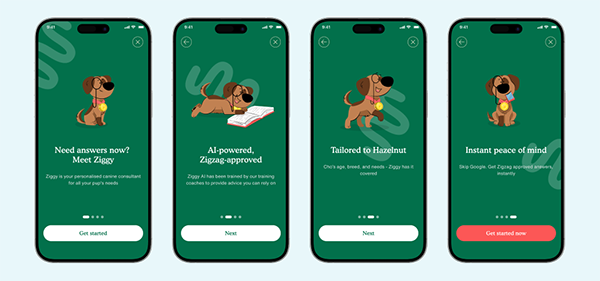
It introduced Ziggy as a friendly cartoon character, offered personalized suggested questions, and clearly distinguished AI assistance from human coaching.
The company also kept human experts involved in validating critical advice.
"One of the key insights was keeping a human in the loop to validate any kind of critical advice," Jack said.
These decisions helped address something that traditional technical evaluations often overlook: the relationship between a person and an AI system.
An AI assistant might generate a perfectly reasonable response. But does the person understand it? Do they believe it? Are they comfortable acting on it?
For enterprise AI leaders, these questions deserve as much attention as model accuracy or response speed.
Human feedback turns AI into a better product
ZigZag didn't wait until launch to discover whether Ziggy worked.
Using UserTesting, the team conducted user interviews, evaluated Figma prototypes, and tested prompts and interactions to understand how customers responded.
The findings weren't always what the team expected.
More than 90% of initial testers expressed interest in the AI chat feature. Yet only 60% showed interest in reading its value proposition.
The lesson? Customers might want the capability without understanding how or why to engage with it.
The team adjusted the experience, improving how the feature was introduced and helping customers discover its value sooner.
"Findings from the tests made us change the way we present information at the first point of entry into the AI chat feature," said Marija Dubovska-Hassan, ZigZag's senior product designer.
This is where human evaluation becomes especially valuable.
Automated testing can determine whether a feature functions correctly. Real people reveal whether the experience makes sense.
And that understanding must continue after deployment. ZigZag regularly reviews customer interactions, ratings, and feedback to refine its prompts and AI responses.
The business results tell a bigger story
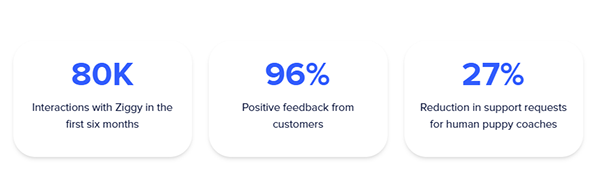
Those results demonstrate more than customer curiosity about AI.
They suggest ZigZag found a way to improve access to support while reducing pressure on its human coaches.
Jack said the company also used A/B testing to evaluate the AI feature's impact on subscriptions and other business metrics, rather than assuming that increased engagement automatically translated into value.
It's a useful discipline for any enterprise AI initiative.
Measure adoption, certainly. But also measure whether the technology improves the outcomes that justified the investment in the first place.
The future of AI still depends on people
ZigZag's experience challenges the assumption that successful AI deployment is primarily a technology problem.
The company combined human expertise to shape the system, real customer feedback to improve the experience, and business metrics to determine whether it was working.
That approach is relevant far beyond puppy training.
Whether an enterprise is deploying customer-service assistants, internal copilots, or autonomous agents, the same questions remain: Does the AI understand the work? Do people trust it? And is it producing meaningful results?
The strongest AI strategies won't simply automate more interactions. They'll create better ones.
As Jack advised other businesses considering AI investments, "Start small, iterate quickly and track that usage, getting those feedback loops from the outset."
Your AI can pass every eval and still lose the customer.
Technical performance is only part of the story. Do people understand your AI, trust its responses, feel in control, and want to use it again?
Auros' AI Relationship Quality (ARQ) benchmark measures how people experience your AI across five dimensions: understanding, trust, control, outcome, and affinity. Get a clear score, real human feedback, and actionable recommendations to improve your AI experience.