The next big threat to AI quality may not be a flawed algorithm. It may be the person who never existed.
As artificial intelligence becomes better at generating convincing language, images, and professional identities, companies face a new challenge: determining whether the human data they rely on actually comes from humans.
For product teams, that raises questions about the customer feedback informing their decisions. For AI developers, the stakes extend to the data used to train models, evaluate performance, and determine whether intelligent agents are ready for the real world.
A model can be technically sophisticated and still learn from unreliable information. A product team can interview dozens of people and still make the wrong decision if those participants aren't who they claim to be.
Human data quality has become an AI development problem.
When bad data looks like good evidence
Consider a company developing an AI-powered financial assistant.
Its engineers have built a system that generates financial forecasts, summarizes reports, and recommends business decisions. Automated evaluations suggest the model performs well.
But can it recognize an unreasonable assumption? Does it understand the financial consequences of its recommendations? Would an experienced CFO trust its conclusions?
Answering those questions requires people with the expertise to recognize mistakes that others might overlook.
Now imagine that some of those supposed financial experts misrepresented their credentials or used generative AI to fabricate their screening responses.
The evaluations might appear credible. Yet the evidence supporting the model's performance would be compromised.
And identifying fraudulent participants isn't always straightforward.
In a User Interviews article examining AI-assisted cheating in research, researcher Emma Spero describes an experiment testing whether researchers could distinguish authentic interview responses from those generated with real-time AI assistance.
Observers correctly classified 64 of 82 judgments. But the most revealing finding concerned their mistakes: when researchers incorrectly identified genuine participants as AI cheaters, their average confidence was 4.5 out of 5.
The lesson extends beyond research interviews. Human intuition alone isn't a reliable defense against increasingly sophisticated AI-generated deception.
The hidden cost of untrustworthy human data
Poor-quality human data creates problems far beyond an individual research project.
For product and R&D teams, unreliable feedback can validate the wrong features, obscure usability problems, and direct engineering resources toward experiences customers don't need.
For AI labs, questionable contributors can introduce noise into training datasets, distort preference rankings, and undermine the human judgments used to evaluate model quality.
And for enterprises deploying AI agents, unqualified evaluators may overlook failures in the workflows those agents are supposed to improve.
The challenge becomes especially consequential as AI moves from answering questions to taking actions.
An agent that incorrectly summarizes a document is inconvenient. One that mishandles a financial transaction or makes an inappropriate decision without human approval introduces a different level of risk.
As explored in UserTesting's article, AI made teams faster. Human insight makes the work better, faster development doesn't necessarily produce greater confidence. In UserTesting's Defensible design in the age of AI, 91% of designers reported working faster with AI, yet only 15% felt much more confident in the quality of their work.
Speed matters. But trustworthy evidence is what helps teams decide whether they're building something worth shipping.
Trust requires more than a checkbox
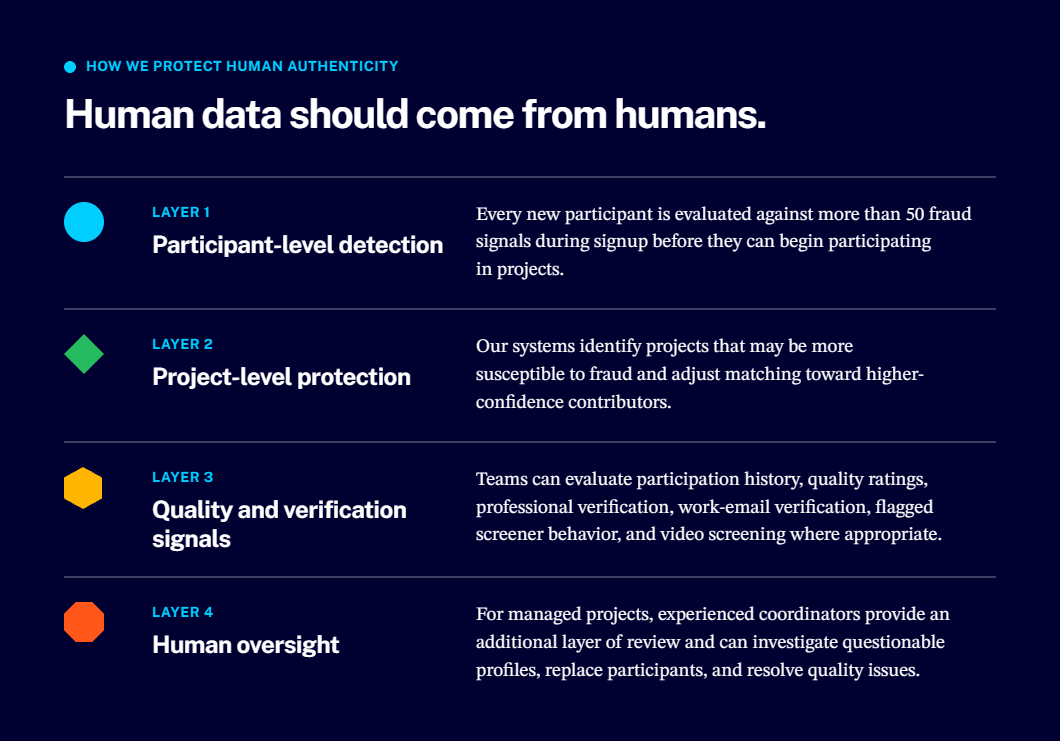
Protecting human authenticity requires multiple layers of verification, not a single identity check.
Auros, the human network behind AI, combines participant screening, professional verification, behavioral signals, fraud detection, and human oversight to help organizations obtain trustworthy human input.
Every new participant is evaluated against more than 50 fraud signals during signup before participating in projects.
Protection continues throughout the process.
Explore the 2026 Auros Panel Book to learn how verified human participants, professional expertise, and layered quality controls help organizations build, train, and evaluate AI with greater confidence.
Auros identifies projects that may be more vulnerable to fraud and adjusts matching toward higher-confidence contributors. Teams can assess participation history, quality ratings, professional verification, work-email verification, and suspicious screening behavior.
For managed projects, experienced coordinators provide additional oversight, investigating questionable profiles and addressing quality issues.
As User Interviews co-founder and Chief Product Officer Dennis Meng explains in Outsmarting fraud: The multi-layer defense system behind our trusted platform, effective fraud prevention requires protections throughout the participant lifecycle.
In one experiment described in the article, directing vulnerable projects toward more trusted applicants reduced the measured fraud rate by 80% compared with the control group. Another experiment found that automatically removing participants displaying suspicious occupation patterns reduced fraud by 25% in projects targeting professionals.
These examples illustrate why fraud prevention must continually evolve as new tactics emerge.
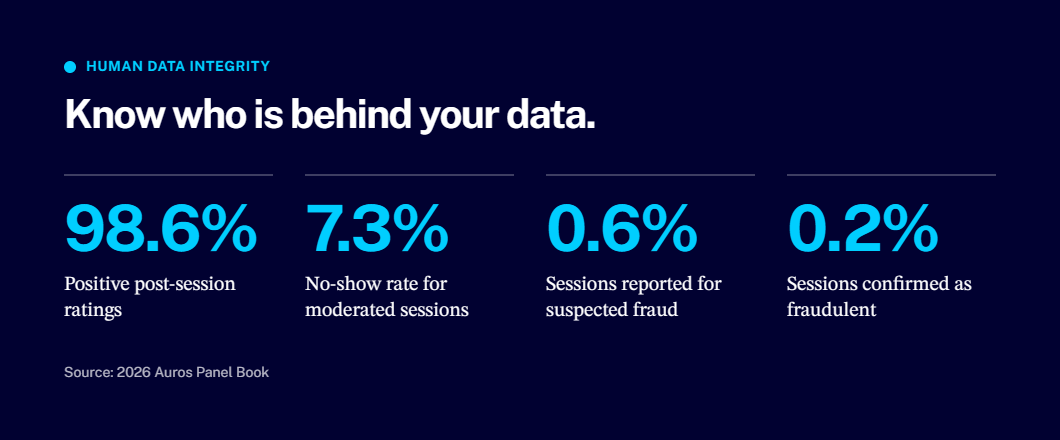
According to the 2026 Auros Panel Book, the network where Auros' proprietary matching and fraud-prevention systems currently operate reports:
- 98.6% positive post-session ratings
- 0.6% of sessions reported for suspected fraud
- 0.2% of sessions confirmed as fraudulent
- Less than one hour median time to the first qualified participant match
No verification system eliminates every risk. But layered defenses make it harder for fraudulent or unqualified contributors to compromise the evidence organizations depend on.
Finding the right human matters as much as finding a real one
Authenticity is only part of the equation.
A genuine participant who lacks the required knowledge can still provide misleading feedback.
A consumer might reasonably evaluate whether an AI shopping assistant is understandable and helpful. That same person probably shouldn't determine whether an AI-generated medical recommendation is clinically sound.
This distinction becomes critical as AI systems grow more specialized.
Auros uses matching technology informed by years of recruiting and participation data to identify contributors based on professional skills, demographics, technology usage, and other relevant requirements.
AI-based matching helps interpret complex qualification criteria beyond simple keyword searches, while custom screening provides another opportunity to confirm fit.
For AI labs, this means finding qualified contributors to generate training data, evaluate model outputs, and identify domain-specific failures. For enterprise AI teams, it means reaching experienced practitioners who understand the business rules, exceptions, and real-world workflows that agents must navigate.
For product teams, it means hearing from the actual customers whose behavior and expectations should guide what gets built.
The objective isn't simply to recruit people faster. It's to connect each task with the human judgment it actually requires.
Better AI begins with better human evidence
AI is making it easier to build products, generate content, and automate increasingly complex work.
But faster development doesn't automatically produce better outcomes.
Product leaders need reliable evidence that they're solving the right problems. AI researchers need credible human judgments to distinguish genuine model improvements from misleading results. Enterprise AI teams need experienced practitioners who can recognize when an agent's behavior doesn't match the realities of their business.
All three depend on the same foundation: knowing who is providing the human input and why their judgment deserves to be trusted.
The next competitive advantage in AI may not come from generating more data.
It may come from knowing exactly which data is worth believing.
How we protect human authenticity
Fraud prevention is increasingly important in an AI world. The goal of human data is to capture real human judgment, expertise, behavior, and experience. That value disappears if the people contributing to the work are misrepresented, automated, or using AI to fabricate qualifications.
Explore the 2026 Auros Panel Book to learn how verified human participants, professional expertise, and layered quality controls help organizations build, train, and evaluate AI with greater confidence.